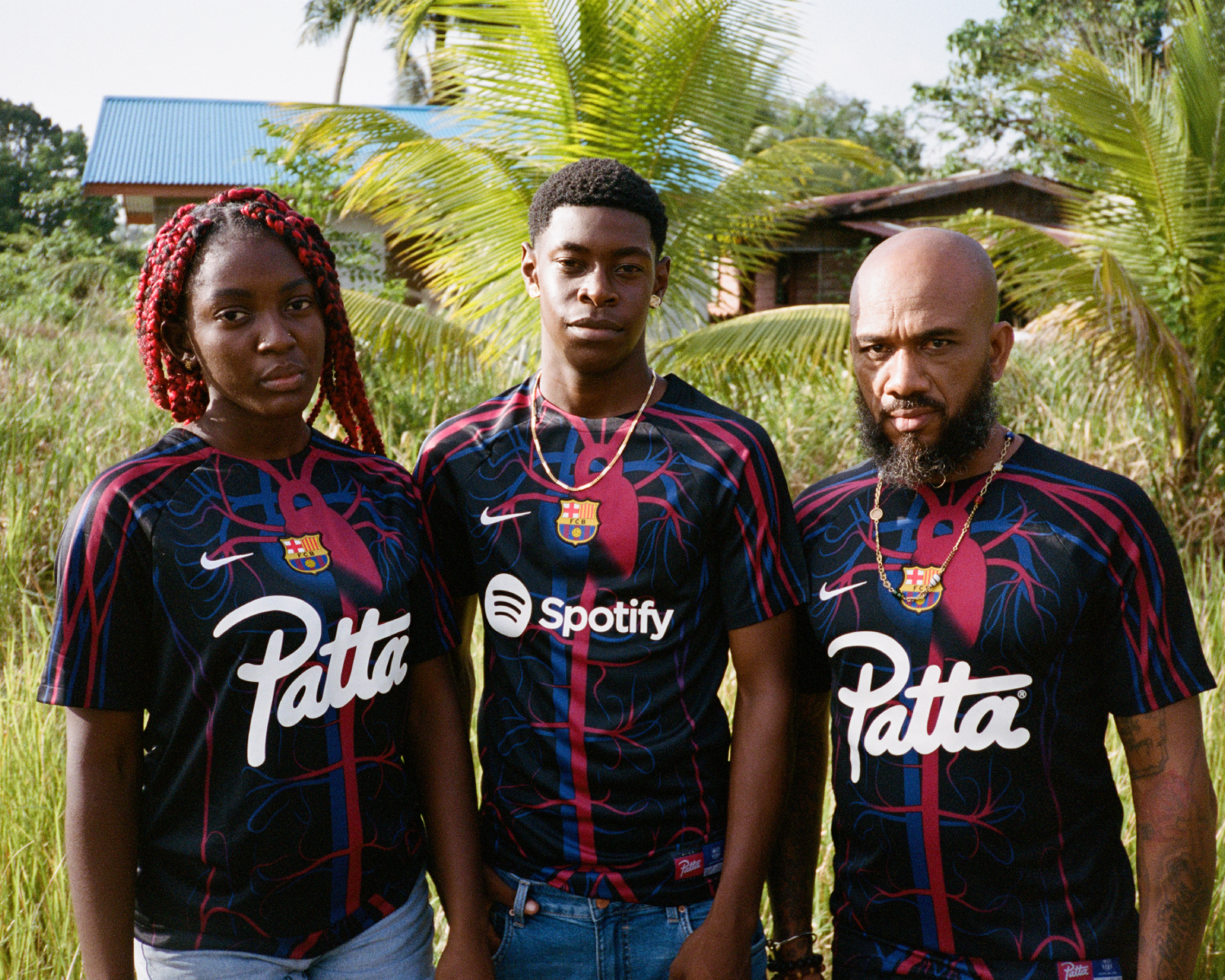

Nike Fc Barcelona X Patta Culers Del Món
-
Partnerships
-
Partnerships

FCB.PATTA.NL
At Patta, football is woven into our very fabric, part of our rich history through jerseys that embody the spirit of the game. This collaboration with FC Barcelona and Nike was a natural fit; we only pursue endeavours that align with our core values. Partnering on this collection has been a dream come true, a testament to our enduring passion for the beautiful game.
Amsterdam and Barcelona, cities with a deep connection across generations, that come together seamlessly in the world of football. The Dutch School's influence continues to shape modern football, with Dutch trainers playing significant roles in FC Barcelona’s rich past. A thread of history connects us - Amsterdam players leaving their mark at FC Barcelona, their journey intertwined with our shared Surinamese roots.
This project's creative canvas pays tribute to our very essence, reflecting the DNA, passion, and love that define true football aficionados. 'Barca-blood,' a metaphorical elixir, that runs through the veins of fans worldwide, uniting us in a symphony of Blue and Red. Blaugrana isn't just a colour scheme; it's a spirit and a legacy. We are Culers del Món, a global community united by our love for FC Barcelona. Our devotion to this club propels us forward in this extraordinary collaborative journey. This collection isn't just about football; it's about a shared heartbeat, pulsating with love for the game and the club that unites us all.
The Nike FC Barcelona x Patta Culers del Món collection will be available Friday, October 13th at 13:00 online and in Patta Chapter stores. A Patta logo pre-match jersey is exclusively available via Patta; while the Spotify logo pre-match jersey is available on Patta, Nike and FC Barcelona sites on Monday, October 16th.
Concept by:
Director: Paul Geusebroek
Creative Director: Vincent van de Waal
Nike Relationships Director: Lukas Nieuwenhuijsen
D.O.P: Menno Mans
Produced by: Iconoclast
Co-produced by: Halal
EP Iconoclast: Francesco Colombo
EP Halal: Job Sanders
AMSTERDAM:
Produced by: Halal /
Producer Surinam + NL: Niels Visser
Producer NL: Janneke Mushonga
Post Producer: Anya Kruzmetra
Lead Production Designer: Miranda Lorenz
Production Design NL: Liz Kooij & Clara Bragdon
Lead Styling: Marion Brillouet / Tirino Yspol
Service Production Surinam
Service Production Surinam: The Back Lot
Producer: Gino Refos (The Back Lot)
Production manager: Esperanza Bodeutsch (The Back Lot)
Styling: Brigitte Hilversum / Tirino Yspol
ICONOCLAST BARCELONA:
EP Iconoclast Spain: Bernard Amsellem
Producer: Isidor Arjona
Production Manager: Arnau Ros
Production Coordinator: Cris Cuello
Editor: Nick Rondeau @ Cabin
Online & VFX: Ambassadors
Creative Director: Justin Blyth
Producer: Carolina van Vugt
Creative VFX Director: Stijn Waterman
Grading: Laurens Orij @ Crabsalad
Sound Designer: Michael Sauvage & Quincy Vlijtig @ Sauavge Sound
Related Articles
-
For nearly twenty years, Blah Records has quietly been proving that there is another way to build a career in music. Not through major labels, algorithm-friendly singles or carefully engineered moments of virality, but through something far less glamorous: consistency. While much of the industry has spent the past two decades chasing the next platform, the next trend or the next shortcut to visibility, the collective has done the opposite. They've built slowly, deliberately and almost entirely on their own terms. That wasn't the plan.When Lee Scott started releasing music in the mid-2000s, streaming platforms didn't exist. Social media wasn't a career strategy and "independent artist" hadn't yet become a marketing slogan. If you wanted people to hear your music, you either convinced someone else to release it or you figured out how to do it yourself. Blah Records was born out of the second option.Long before the label became one of the defining names in British underground rap, Scott and his friends were burning CDs at home, selling them through MySpace and posting them out one order at a time. There was no business model, no investment and certainly no ambition to build an institution. Every milestone that followed was simply the solution to whatever problem lay in front of them.Need more CDs? Get them replicated. Need distribution? Start a label. Need somewhere to perform? Book the show yourself. Need a scene? Build one.Looking back, it's easy to mistake that progression for careful planning. Spend enough time talking to Lee Scott and Black Josh, however, and another picture emerges. Blah wasn't built around some master strategy. It was built through momentum. Every decision led naturally to the next until, almost without noticing, they had created an ecosystem that could survive without asking anyone else for permission.Today that ecosystem stretches far beyond a record label. Blah has become home to one of British rap's most distinctive communities, producing solo records, collaborative projects, Cult of the Damned releases and an audience that has remained fiercely loyal despite existing almost entirely outside the machinery of the mainstream music industry. In an era increasingly dominated by playlists, engagement metrics and fleeting internet fame, that longevity feels almost radical.Fresh from an independently organised Australian tour and preparing to release their collaborative album It Made Sense at the Time, Scott and Josh aren't interested in celebrating survival for survival's sake. They're far more interested in whatever comes next. The conversation moves effortlessly between British rap's formative years, regional identity, creative discipline, disastrous tours and the peculiar satisfaction that comes from solving your own problems. Throughout it all, one idea keeps resurfacing. Blah never waited for an industry to believe in them. They built their own.Ask Lee Scott how Blah Records began and he almost sounds amused that anyone would imagine there was a grand design behind it. "There wasn't some master plan," he says. "We just needed somewhere to put our music out."It's an answer that immediately dismantles nearly twenty years of mythology. Blah has become one of British rap's defining independent institutions, but its origins were almost laughably ordinary. Before the label existed, Scott and his friends were already operating under the Anti-Heroes banner, recording mixtapes, burning CDs at home and selling them directly through MySpace. Every sale arrived through a tiny PayPal button embedded on a profile page. When somebody placed an order, another disc was burned, packaged by hand and taken to the post office."It was DIY before people even called it DIY," Scott recalls. Eventually the limitations of that approach became impossible to ignore. Burning individual CDs wasn't sustainable, so the group ordered a thousand professionally replicated copies. Suddenly they had boxes of records stacked around them and no way of getting those records into shops."The next logical step was distribution," Scott says. "Then the next logical step after that was creating a record label." That practical way of thinking has remained remarkably consistent throughout Blah's existence. Every obstacle simply became another task to solve. When their friend Alex — better known as Swiss — moved back to Switzerland after handling much of the label's early administration, Scott reluctantly found himself responsible for the business side too. "If you've met me," he laughs, "you'll know administration probably isn't where my strengths lie." Even so, the work got done.Looking back, Scott doesn't romanticise those early years. He doesn't describe them as visionary or revolutionary. Instead, he talks about them with the matter-of-fact tone of somebody fixing one leaking pipe after another. That mindset, more than any business strategy, would eventually define Blah Records. Because independence, for them, was never an identity. It was simply the only option.The story of Blah Records is often told through releases, tours and milestones, but Scott insists those things arrived much later. Before there was a label, there was simply a group of friends making music together because they enjoyed each other's company."The original crew was me, Salar, Bill Shakes and Tony Broke," he says. "I'd known some of those people since I was sixteen. Before there were labels or tours, we were just hanging around."As the years passed, that circle naturally expanded. Friends from London became collaborators. Manchester, Blackburn and Liverpool slowly blurred into one community. The geography changed, but the logic never did. Relationships came first. Music followed.That's perhaps why Blah has always felt different from a conventional record label. It doesn't operate like a roster assembled by A&R executives searching for complementary artists. It feels more like a constantly evolving friendship group whose members happen to make records together."When people describe Blah as a company, it always sounds a bit strange," Scott says. "Everyone on the label is someone I'd happily spend time with whether music existed or not."That chemistry explains why the catalogue is filled with collaborations that never feel manufactured. Duo records, posse cuts and one-off projects emerge organically because the artists already share the same spaces. They're in the studio together, travelling together or simply spending weekends together."If you're already sitting in the same room with your mates," Scott shrugs, "eventually somebody says, 'Let's make a tune.'"It's an understated observation, but one that reveals something fundamental about Blah's longevity. The label was never sustained by contracts or commercial obligations. It was sustained by genuine relationships. Long before "community" became one of the music industry's favourite buzzwords, Blah had accidentally built one.That sense of community extends beyond the artists themselves. Fans don't simply consume the music; they participate in the world around it. Shows feel less like isolated performances than reunions. Faces become familiar. New listeners are introduced by old ones. Records are bought not because they're being pushed by an algorithm but because people genuinely want to support the artists making them.It's a slower kind of growth, but one that's proved remarkably resilient. For listeners discovering Blah today, it's easy to forget just how unusual British rap once sounded. Or perhaps more accurately, how unusual it didn't. "When I first started recording," Scott says, "I was doing an American accent."He laughs as he says it, but the admission reflects a much broader moment in British hip-hop history. Throughout the late nineties and early 2000s, many UK rappers borrowed not only the sound but the cadence and pronunciation of the American artists they'd grown up listening to. Regional British accents were often viewed as obstacles rather than identities.Scott didn't think he was pretending to be someone else. He simply hadn't heard an alternative. "I'd literally never heard anybody from where I came from rapping," he says. "I wasn't trying to copy anyone. I was just imitating the music I loved." The turning point came through an unexpectedly simple question. Somebody older asked him why he was rapping in an American accent. "It sounds ridiculous now," he says, "but I'd never even considered there was another option."The internet was still fragmented. Music discovery relied on word of mouth, independent record shops and whatever happened to circulate through local scenes. Liverpool wasn't necessarily listening to London. Manchester wasn't constantly aware of what was happening in Glasgow or Bristol. Regional scenes often developed in parallel rather than together. "You had to actually go and find music," Scott remembers. "People forget that. You weren't endlessly scrolling."As British rap slowly became more confident in its own identity, artists across the country began embracing the voices they'd previously tried to suppress. Looking back, Scott describes hearing those records for the first time as strangely unfamiliar. "I'd spent so long listening to American hip-hop that hearing British accents almost sounded weird."Today, that idea feels almost impossible to imagine. Black Josh belongs to the generation that inherited that shift rather than initiating it. "For me, hearing Children of the Damned was massive," he says. "Those were actual regional accents. Not fake American voices. Just people sounding like where they were from." Around the same time, grime was making a similar argument from London. "When Dizzee Rascal came through, nobody thought he sounded American," Josh says. "He sounded exactly like London."For him, hearing Mancunian voices carry the same confidence was equally significant. It demonstrated that authenticity wasn't something to be polished away. Your accent wasn't a limitation. It was part of the music itself. That evolution mirrored Blah's wider philosophy. Just as they refused to imitate the industry's business model, they also refused to imitate someone else's identity. Instead of asking how close they could get to American rap, they asked a different question altogether. What would this sound like if it could only have come from here?The word independent has become one of the music industry's favourite buzzwords. It's applied so liberally that it has almost lost its meaning. Artists backed by distribution companies, management agencies and major-label funding routinely describe themselves as independent, often because they technically own their masters.Lee Scott has never been particularly interested in the distinction. "I don't think we ever called it a philosophy," he says. "It was just survival." That difference is important.Blah wasn't founded because its members rejected the music industry. It was founded because, at least in those early years, the industry simply wasn't paying attention. There was no queue of labels waiting to sign them, no established touring circuit for the kind of music they were making and no blueprint for building a career from regional underground rap. Rather than waiting for those opportunities to appear, they created their own."If nobody wanted to release the record, we'd release it ourselves," Scott says matter-of-factly. "If nobody booked us, we'd book our own shows. If nobody wanted to distribute it, we'd figure that out as well."Looking back, it's tempting to describe those decisions as visionary, but Scott refuses to romanticise them. Every milestone emerged from necessity rather than ambition. Every solution created another possibility."I think people assume we've always had this machine behind us," he says. "But every stage has been built from the previous one. You don't suddenly wake up with a functioning label, an audience and touring infrastructure. You spend years solving one problem after another until eventually you realise you've accidentally built an ecosystem."That ecosystem has become Blah's greatest achievement. Long before artists were talking about direct-to-fan relationships, Blah were cultivating one. They weren't simply releasing records. They were creating an audience that felt personally invested in everything surrounding the label. Shows became meeting points. Collaborations happened naturally because the artists already occupied the same spaces. Every release strengthened the world around it instead of existing as a standalone product.The result is a model that feels increasingly unusual in an age dominated by short attention spans. Rather than chasing as many listeners as possible, Blah focused on building deeper relationships with the ones they already had. Scott has little interest in viral success. "I'd much rather have a thousand people who genuinely care than a million people who watched something for fifteen seconds because an algorithm showed it to them."To him, longevity has always been a far more meaningful measure than visibility. "A career is people buying your records ten years later. It's somebody travelling across Europe to see you perform. It's fans introducing your music to their kids."Streaming numbers rarely tell that story. "If people are buying vinyl, buying merch and coming to shows," he says, "that's a community." Black Josh has seen that difference firsthand every time the pair step on stage. "Our crowds aren't there because one song blew up six weeks ago," he says. "A lot of them have been listening for years. They know album tracks. They know lyrics that were never singles. Some of them have literally grown up with us." He pauses before smiling. "That's worth way more than a number on a screen."That same practicality extends into Blah's creative process. The label's distinctive visual language — grainy music videos, surreal artwork and unmistakably DIY aesthetics — has become part of its identity, but Scott insists very little of it was ever planned.People often assume the rough edges are deliberate, an aesthetic statement designed to separate Blah from polished commercial rap. In reality, they were usually the product of limited budgets, available time and whoever happened to own a camera."Sometimes we'd literally wake up and decide to shoot a video that afternoon," Scott says. "You'd ring a mate, drive somewhere, film it, edit it... done."That approach eventually became a philosophy in its own right. "People read all sorts of meaning into it," he laughs. "Honestly, we just wanted to get things made." Perfection has never interested him as much as momentum. "I'd rather finish something that's eighty or ninety percent there than spend two years chasing perfection and never release anything."It's a lesson he's applied across almost every part of his creative life. Songs, artwork, videos — eventually everything reaches the same point where further refinement begins stripping away the spontaneity that made it compelling in the first place."Sometimes the first version captures something the twentieth one doesn't," he says. "You've got to know when to stop." That instinct has also shaped projects like Cult of the Damned, a collective that has become almost mythical within British underground rap. While fans often speak about it as though it were carefully curated, Scott remembers something much looser."There wasn't loads of planning," he says. "It was more like, 'Who's about today?'" The chemistry came from unpredictability. Throw eight or nine entirely different rappers into the same room and nobody knew what would happen next. "You could hear people enjoying themselves," he says. "I think listeners can tell when that's genuine." For Black Josh, that unpredictability also created a healthy sense of competition. "If you're on a track with six other rappers," he laughs, "you definitely don't want to have the weakest verse." Nobody coasted. Everybody pushed each other. Without anyone saying it out loud, the standard kept getting higher.For a label approaching its twentieth anniversary, Blah spends remarkably little time looking backwards. The Australian tour is a perfect example. From the outside, it looked like another milestone for a collective that has steadily expanded its reach without compromising its identity. Behind the scenes, however, it nearly collapsed before it began."Everything that could go wrong basically did," Scott says. "People disappeared. Plans changed. Money vanished." At one point, the tour looked beyond saving. Most artists would've cancelled. Scott admits they probably should have. Instead, they did what Blah has always done. They solved the next problem."I think we ended up spending something like twenty-five grand in the space of a week just to keep everything alive," he recalls. "It was terrifying. But once we'd committed, there wasn't really another option. You either lose everything or you make it work." Eventually, they made it work. Black Josh laughs at how differently those moments are remembered by everyone else. "People only see the photos afterwards," he says. "They see sold-out rooms, happy faces, everyone smiling. They don't see the weeks beforehand where you're wondering whether you've just made the worst financial decision of your life." He shrugs. "That's touring when you're doing it yourself."It's a story that feels strangely representative of Blah as a whole. The audience sees the finished record, the packed venue or the sold-out vinyl pressing. What they rarely see are the years of incremental problem-solving that made those moments possible in the first place. That same philosophy continues to shape the music itself.Despite the longevity of the label, neither Scott nor Josh speaks like someone preserving a legacy. The new collaborative album, It Made Sense at the Time, isn't presented as the culmination of twenty years' work, but simply the latest chapter in an ongoing conversation they've been having for most of their adult lives."If it ever started feeling like a job," Josh says, "I'd probably lose interest." Touring is work. Running a label is work. Answering emails is certainly work. Making music, however, remains something else entirely. "That's still the fun bit," he says. "That's still me and Lee sitting in a room making each other laugh."Scott's process hasn't changed much either. Ideas still arrive unexpectedly—sometimes while he's asleep. "I'll literally wake up with a line in my head," he says. "If I don't write it down immediately, it's gone forever." His phone is filled with half-asleep voice notes recorded in the middle of the night. Some become songs. Others make no sense whatsoever. "I'll listen back a week later and think, 'Actually... that's not bad.' Or I'll think, 'What on earth was I talking about?'" He laughs. "Either way, that's always been my process." The instinct to trust the first idea, to keep moving and to resist overthinking, extends beyond songwriting. Scott has never been interested in endlessly polishing creative work for the sake of perfection. "Sometimes the first version captures something the twentieth one doesn't," he says. "You've got to know when to stop."It's advice that feels increasingly relevant in a music industry obsessed with optimisation. Artists are encouraged to chase trends, feed algorithms and treat every platform as though it might determine the course of their careers. Scott sees that as a dangerous way to think."Don't build your career around something you don't control," he says. "Algorithms change. Platforms disappear." The things that actually endure, he argues, are much simpler. "The work. Your audience. Your reputation." Everything else comes and goes. Josh agrees."The quickest way to make yourself miserable is comparing yourself to everyone else," he says. "Somebody will always have more followers. Somebody will always have bigger numbers. That doesn't mean they're making better music."For both of them, curiosity remains a far stronger motivator than recognition. "I've never really been interested in proving people wrong," Scott says. "I'm much more interested in proving to myself that I can still make something exciting."Every record, he believes, should surprise him. "If I already know exactly how it's going to sound before I make it, then what's the point?" Josh nods. "I don't really think in terms of legacy," he says. "People talk about legacy when they're looking backwards." He smiles. "We're still looking forwards."Nearly twenty years after its founding, Blah Records remains one of the rare examples of independence that extends beyond ownership. It isn't simply a label operating outside the mainstream; it's an ecosystem built through patience, friendship and an unwavering belief that if something doesn't exist, you can create it yourself. Every record, every tour and every collaboration has been another step in a process that was never meticulously planned, only continually refined.Blah never set out to become a blueprint for independent music. Lee Scott and Black Josh simply kept making the next record, booking the next tour and solving the next problem in front of them. Looking back, that's exactly what made them one. -

What went down at the Free The Youth x Jordan launch
What went down at the Free The Youth ...
Photography by Sandra NagelRecently, we welcomed Ghana’s Free The Youth to Patta London to celebrate the launch of their landmark collaboration with Jordan Brand. The Accra-based collective continues to push Ghanaian creativity onto the global stage, becoming the first Ghanaian brand to collaborate with Jordan Brand and bringing their own perspective, community and culture to one of footwear’s most iconic names. Friends and family came through the London Chapter to celebrate the release, with music, good energy and drinks provided by our friends at Mirchi. Big love to everyone who joined us, and congratulations to Free The Youth on a major moment for Ghanaian streetwear.-
What Went Down
-
-

Benny Sings - You Love Me
Benny Sings returns with “You Love Me,” a tender new single taken from his forthcoming album 22 Durnham Dew, out September 25 via Stones Throw / Sings Records. A love duet sung with his wife, Joline van Berkestijn, the track finds Benny turning everyday moments into something warm and deeply personal. Accompanying the release is a self-directed music video filmed in Paris, extending the song’s intimate feel through a simple, understated visual. Watch the music video for “You Love Me” now.-
Music
-
-

Patta Paris Cypher 2026
For Fête de la Musique 2026, Patta brought together some of the finest voices from the Paris underground scene for a live rap cypher. Wata MC, Dooky, James le J, Costa, Inférieurà3, Radou, D2R, L'Ultra, Oussoum, Robinin, Dre, Ismayyyel, Kun and Nanor took over the mic while DJ Cheetah held it down behind the decks. Special thanks to Oroko Radio for the broadcast, Le Cercle, Vicky R, and Daymolition for the artist curation, and to Café de l'Arc for the stage.-
Music
-
-

Erykah Badu & The Alchemist - Witch Doctor
Erykah Badu & The Alchemist - Witch D...
Erykah Badu and The Alchemist link up on “Witch Doctor,” a hypnotic, slow-burning track that blends Badu’s unmistakable presence with Alchemist’s hazy, sample-driven production. Eccentric, soulful and effortlessly off-kilter, the collaboration feels exactly as strange and natural as you’d expect from two artists who have spent their careers creating worlds of their own. Watch the “Witch Doctor” music video now.-
Music
-
-

Victory Lap: TRAINING MODE VOL.1
Victory Lap Radio presents Training Mode Vol.1 (2025) a documentary showcasing the new voices of the UK. Featuring 25+ artists and shot all over London in 2025.-
Film & Documentaries
-
-

Layers - Pen & Pixel
Shawn Brauch, the visionary co-founder of Pen & Pixel, designed over 20,000 iconic album covers. Pen & Pixel hand-crafted the wildest, diamond-encrusted album art in music history. We’re diving into Shawn Brauch’s genius and the practical effects behind 90s rap’s most legendary visuals. Here is the story of the man who illustrated the bling era. In this episode of "LAYERS", Shawn Brauch walks us through how he designed album covers for Master P, Snoop Dogg, and Lil Wayne using Adobe.-
Art
-
-

Free The Youth x Jordan at Patta London
Join us at Patta London to celebrate the launch of Free The Youth x Jordan. Thursday, August 13th, 18:00 - 20:00. Music by Selassie TBC. First come, first serve.-
Events
-
-

What went down at the Tiwa Savage meet & greet
What went down at the Tiwa Savage mee...
Photography by Andrea AmponsahThis past Sunday, August 9th, we had the pleasure of hosting the legendary Tiwa Savage at our Patta Amsterdam store for an exclusive meet-and-greet. Patta Amsterdam served as a vibrant bridge that brought together different circles and many new faces into the store. It was a unique opportunity for the community to connect with a global Afrobeats icon and one of Nigeria’s most influential artists in an intimate setting. As the first woman to win the MTV EMA for Best African Act, Tiwa Savage continues to shape the sound of a generation, and seeing that energy reflected in our space was a true victory for the Patta community. Thank you to everyone who came through and made this afternoon special. We look forward to continuing to expand our community and connecting with you all through more moments like this in the future.-
What Went Down
-
-

Lee Quiñones for Patta Magazine
Words by Andy Thomas In 1978, Lee Quiñones’ iconic mural Howard the Duck appeared on a handball court wall in the Lower East Side near where the 18-year-old had lived since arriving as a child from Ponce, Puerto Rico.The first freestanding urban mural to appear in New York was a symbolic moment for graffiti art’s emergence out of the underground, with walls replacing metal as the young artist’s urban canvas.Quiñones began spray-painting subway trains at 14 in 1974, creating ambitious murals in train yards on the Lower East Side. Two years later, Quiñones and the Fabulous Five crew had the audacious plan to paint an entire 10-car subway train with a mural that would make them folk art heroes across the five boroughs.These acts of artistic genius and ingenuity would prove as important to the evolution of hip-hop culture as DJ Kool Herc’s Back to School Jam at 1520 Sedgwick Ave in 1973, fellow Bronx schoolboy Grand Wizzard Theodore inventing scratching in 1975, and the arrival of “Rapper’s Delight” by the Sugarhill Gang in 1979.Another big moment in hip-hop was Charlie Ahearn’s Wild Style, which starred Quiñones as the semi-autobiographical Zoro. Ahearn became aware of Quiñones when he came across the Howard the Duck mural while filming his martial arts movie The Deadly Art of Survival on the Lower East Side with his Super 8 camera.In June 1980, Ahearn and his cohorts in the arts collective Colab transformed a three-storey building on 41st Street and Seventh Avenue into The Times Square Show, a DIY exhibition that, in the words of the Village Voice, was “the first radical art show of the ’80s”.It was also an important moment in the history of graffiti art, with Lee Quiñones and his Fabulous Five partner Fred Brathwaite (AKA Fab 5 Freddy) displaying works alongside around 100 other artists, including Kenny Scharf, Jean-Michel Basquiat, and Keith Haring. It was there that Ahearn met Brathwaite, who would introduce the filmmaker to Quiñones.Through his social commentary and poetry used in his expressionistic work with messages like “If we don't use our heads now we may lose our tails later” Quiñones had been speaking directly and profoundly to the marginalized from the streets where he was raised. But Quiñones had ambitions for his art and culture that went well beyond the Lower East Side.The December before The Times Square Show, an art collector named Claudio Bruni had invited Quiñones and Fab Five Freddy to exhibit at his Galleria La Medusa in Rome. It was the first step towards propelling Quiñones into the international art market and giving graffiti art the same attention and respect as other art movements - from pop art to abstractionism.By the mid-’80s, Quiñones was participating in groundbreaking group shows like Arte di Frontiera: New York Graffiti in Italy and Documenta 7 in Kassel, Germany. As the graffiti art he pioneered became recognized as a serious art movement in the years that followed, Quiñones continued to expand his artistic vision. Today, his works are displayed in the world’s leading museums - from MoMA in New York and Pérez Art Museum Miami to Museum Ludwig in Köln.In October 2025, he held his first solo exhibition in London for 40 years, Outside Is America, an intersection of old and new works that spanned his career - from iconic spray paint pieces like the self-titled Lee from 1979 to contemporary mixed material works such as Heart in a Hurricane from 2025, created from his Bushwick studio.With a lineage that reaches back to the mid ’70s, these works continue Quiñones'mission to communicate using a combination of striking visual symbols and written messages. Through empathy and resistance, his addressing of political and socio-economic issues in the age of Trump and the dark dystopian forces of ICE is needed more than ever.As Outside Is America drew to a close, we caught up with the artist to talk about the works displayed at Woodbury House and how they speak to contemporary America.“Art arrives at the time it deserves”, says Lee Quiñones. “I’ve always been at the forefront of something while also realizing I’m just following a lead of something bigger than myself. I think every artist has a responsibility to be committed to what they do in their time. Art does percolate under the surface until it comes up with something to say at a particular point in time. Creating art is in itself a political act. In some cases, a rebellious act; in most cases, an urgent act.“Titles have always been important to my work and they often speak to me before the work becomes a tangible thing. I want the work to correspond to the title and vice versa. With this show, I wanted to talk to people outside of my country as an American with what we are going through today. This is nothing new, though. We’ve always lived in the abyss of the hypocrisy of humankind. But I’m a firm believer that the forces of good can be more powerful than the forces of evil.”HEART IN A HURRICANE“I had found this old vintage flag in the Brooklyn Navy Yard back in the mid-’90s that had been sewn together, not printed. This was a beautiful piece - it was more than a piece of fabric, it was the fabric of the country. But it started to get me thinking about all the atrocities over time in America. When you think about personal moments, you can go back to Mildred and Richard Loving, the interracial couple in the ’50s who married and went through hell just for being in love. Then, into today with Colin Kaepernick (of the 49ers). He’s not stepping on the flag or burning the flag; he is kneeling to bring a justifiable awareness of this country’s issues with its dirty dishes. Now I’m Puerto Rican, and we have our very rightful gripes and rifts with our country for obvious reasons. So I’m always going to have a rebellious part of me. But in this piece, which is a self-portrait, I’m not rebelling or lashing out; it’s a very tender moment. I’m lying down with a rose in my hand to show a love of country. But you can’t love a country if you can’t question the country.”UNFOLDED“Ori Carino is an Italian American who, like me, grew up on the Lower East Side and was inspired by my art. But he was also a huge inspiration to me, another man from the Lower East Side with whom I shared concerns and pride. Here are two men of Puerto Rican and Italian descent. The main reference of these two things combined is West Side Story. As beautiful as that story is, it's also a tragic story of migration. The real genius behind that painting is Ori Carino - he said to me, ‘Lee, I’m making these paintings on these layers of synthetic silk.’ So I went down to his studio, and I was floored. He told me he wanted to do a collaborative piece about the layers and layers of immigration and the different conversations and arguments over the centuries. So I was like, ‘Wow, this is great karma for us coming together.’ It was a beautiful collaboration even before we pulled the trigger on the paint. And the results were amazing.”TABLET #9 “These writings taken from studio walls are what I call soundboards. I think of them as liquid daily diaries of my thoughts, my isms, my poetry, that come to me now and then. Sometimes I feel as dumb as a church mouse. I just can’t talk, spell, or remember anything. Then the next day, I wake up, and I just spill out all this poetry. Lots of it makes sense, and much of it doesn’t at that time. But maybe it will become something that I will work out later in another painting. These ideas can be playfully funny or darkly poetic. The idea is you don’t hit people over the head with things, but you get them to think through the usage of words. I heard Basquiat say once that he would cross out words so people would be attracted to them. It got people thinking, ‘Why did he cross that out? What did he write?’ And sometimes the lack of words is more powerful and gets people thinking, ‘What is that about?’”LEE“This was one of a batch of paintings that I created between 1979-80, trying to exorcise myself from the fringes of the subway art era. That time was so powerful and special for me. It saved my life even though I was always putting my life on the line. It saved me from the abyss of my neighbourhood. I had painted in the dark about dark times for years. But in that darkness, I painted in the brightest colours because I wanted to bring this banquet of flowers to people. Lee featured in the 1979 exhibition The Fabulous Five at Galleria La Medusa in Rome [the first European exhibition to showcase artists from the graffiti movement], organized by gallerist Claudio Bruni. When we write, something comes out through us.”HONEST GEORGE“Honest George is rooted in the fairy tale of Little Red Riding Hood. It’s one of a series of pieces I’m doing based on all these follies and tales we hear as children, and on how we structure our beliefs about them and relate them to the real world as it unravels. My moral compass is angry, so my work relates to the hypocrisy of the human experience. But today my work goes all over the place. There are times that I do go into a rhythm, but I only stay there as long as I need to. My art will never be repetitive or redundant. I never want to be put in a corner. As artists, we have to switch gears; otherwise, we are going to burn the clutch.”